In this article
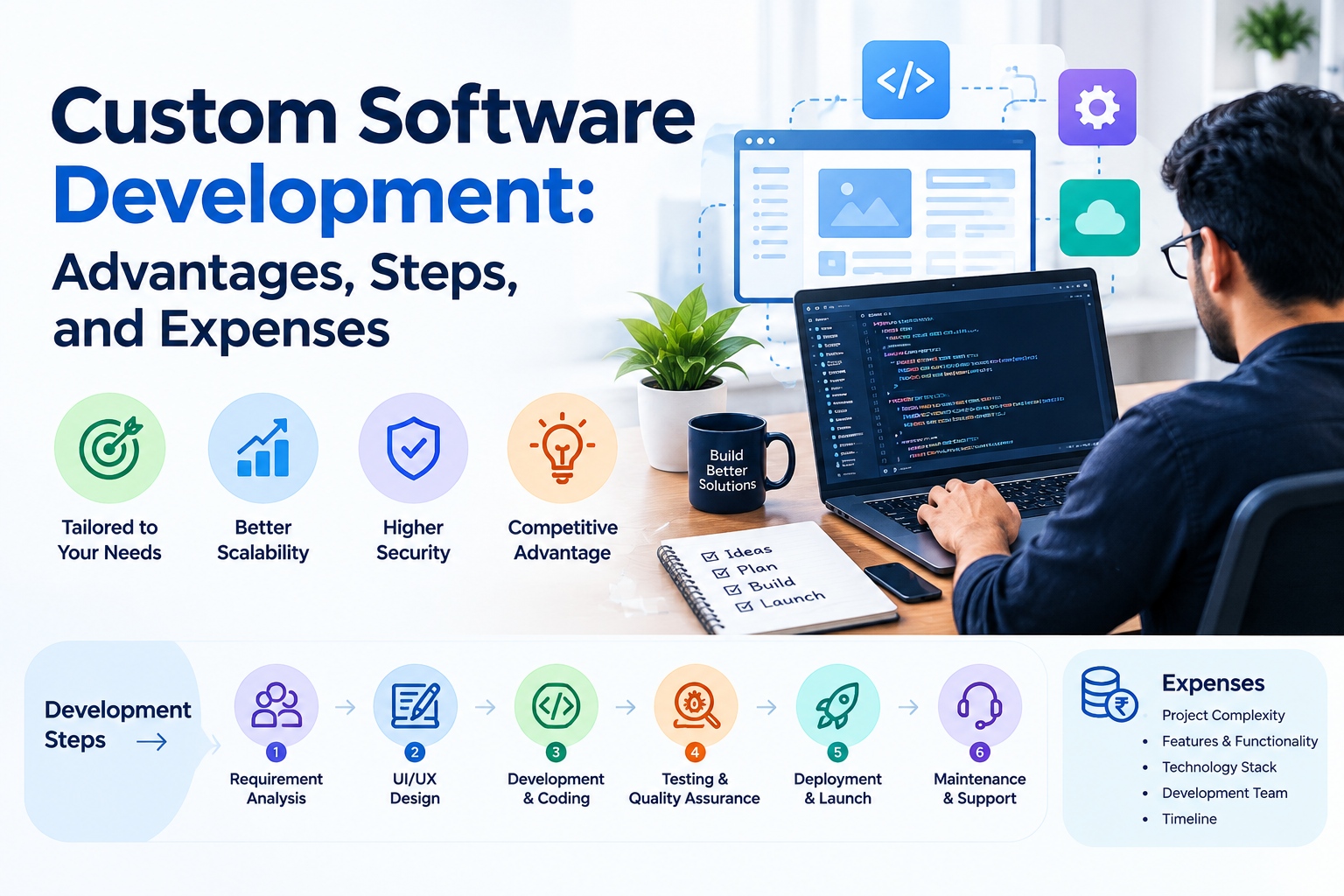
Every company faces certain issues with its workflow, operation, and growth needs. Even though ready-made software could be helpful in most cases, it is not always the case. That is why custom software development is a good idea.
It allows companies to build their software solutions according to their business needs and use them for streamlining processes, integrating systems, managing information, and growing. Custom software could be anything from internal business management systems to customer-oriented web applications.
The development of custom software requires time and money but the knowledge about it might help in making your decisions. In this article, you will learn what custom software development is, how it is different from ready-made software, and what should be considered during its development.
What is Custom Software Development?
Custom software development is the activity of planning, designing, developing, testing and supporting software products that are customized for the specific needs of a certain organization. This way, instead of tailoring business processes to suit the standard product, organizations can have software designed to suit their processes.
Custom software can be anything from web applications, business management software, customer portals, workflow management software and connecting software that links different business applications.
For instance, there could be a need in a logistics company for software to help with managing delivery, tracking shipments and coordinating drivers. There would be a need in a retail business for software to help link inventories, orders, customer details and reporting.
The functions and structure of the software depend on the challenges it will tackle, user population, security issues, infrastructure and future growth potential.
Custom Software and Off-the-Shelf Software
Firms usually consider using off-the-shelf software or developing custom software. The choice is made based on the firm's need for customization, budget, and future prospects.
| Factor | Custom software | Off-the-shelf software |
|---|---|---|
| Functionality | Designed around specific requirements | Offers predefined features |
| Initial investment | Can require a higher upfront investment | Often has a lower initial cost |
| Customization | Can be tailored to business workflows | Limited by available customization options |
| Integrations | Can be designed for required integrations | Depends on supported integrations |
| Deployment time | Usually requires planning and development | Often available for immediate use |
| Maintenance | Requires an agreed support and maintenance plan | May be managed by the software provider |
| Scalability | Can evolve with changing requirements | Depends on the product's capabilities and plan |
What is the best choice for you?
Out-of-the-box software is frequently applicable if there is an application that satisfies your needs at a good price. Custom development might suit your needs if your company has unique processes, integration capabilities that are not available in current software, or more control over features is needed.
Before going ahead with custom development, make sure to compare the cost of ownership.
Advantages of Custom Software Development
1. Unique Software for Your Specific Requirements
Every business has unique operational needs. When using custom software, companies do not have to pay for the functionality that they will not use.
Custom software can include your company's current procedures, reports, customer journey, etc. It can streamline operations and minimize the number of redundant actions.
2. Enhanced Operational Efficiency
A large number of companies still work with spreadsheets and other tools, which require them to perform many actions manually.
Custom software can automate selected operations, unify all data, and standardize all recurring processes. The process of order update, generation of report, and routing of requests to the correct person is an example.
It should be noted that efficiency depends greatly on the implementation quality and user adoption.
3. Integration With Existing Systems
Companies often rely on separate solutions to manage their clients, accounting, inventory, sales, and reporting. Coordinating information within those solutions leads to inconsistencies and redundancies.
The custom solution can integrate compatible systems through APIs, connectors, or any other means. It might enable information exchange between systems and provide a unified view of company operations for teams.
It is necessary to consider capabilities of the systems, their documentation, permissions, and technical constraints when assessing the feasibility of integration.
4. Flexibility and Scalability
The requirements of a company tend to evolve with product launches, market expansion, personnel increase, and the introduction of new services.
A properly developed custom application can be adapted to address those needs. However, scalability should be planned when designing the architecture and the infrastructure of an application, as it is not granted by being custom-made.
5. Greater Control Over Features and Development Priorities
Custom software provides businesses with greater control over feature priorities and workflow, as well as over further development of the application.
This capability can be especially valuable when the off-the-shelf solution lacks certain functionality necessary for operational processes. Documentation, proper licensing, and maintenance plan are crucial for preserving control over the software.
6. Improved Alignment with Business Objectives
It is possible to develop custom software with clear business goals like decreasing processing time, enhancing reporting accuracy, streamlining customer registration, or connecting disjointed systems.
The identification of such business objectives prior to development makes it easier for developers to choose features that matter and measure the success of software post-deployment.
Some Custom Software Applications for Various Industries
Custom software can be helpful to various industries and different areas of operations within an organization. Here are some examples.
Retail/Ecommerce
Retail stores may need to develop custom software for inventory management, order processing, fulfillment processes, and integration of offline and online sales channels.
Such software will allow consolidating data from compatible software and facilitate special processes within the business.
Healthcare
The healthcare sector may need to develop appointment management software, patient portal software, administration software, and report generation software. This type of software should take into account the necessary privacy, access, security issues, and other regulatory requirements.
Logistics/Transportation
Logistics companies may find useful custom software that helps to organize deliveries, control delivery status, manage drivers, and generate reports. These processes can be integrated in order to give more consistent access to data and detect any delays or inefficiencies in the workflow.
Manufacturing
Custom software can be developed by manufacturing businesses for managing the production schedule, inventory, quality control, equipment records, and reporting processes.
Features should be determined by the production processes and the systems used by the company.
Professional Services
For consultancies, agencies, and other service providers, features could include project management capabilities, client portals, resource management software, or reporting tools.
These features could be bundled together through custom software solutions.
Steps in the Custom Software Development Process
Writing code is not enough to ensure the success of any project. Following an organized process can help development teams to define requirements, handle risks, verify functional performance, and achieve project goals.
1. Requirements Gathering and Discovery
The process starts with defining the business problem, targeted users, current processes, and expected results.
In the discovery phase, the team outlines the necessary functionalities, technical requirements, integrations, restrictions, and priorities of the project.
All this information will become a starting point for the further development.
2. Project Planning and Technical Architecture
Having gathered all the required information, the team can start defining the project scope, milestones, technologies, system architecture, and resources needed for development.
Security, scalability, data management, external dependencies, and further maintenance are also considered at this step.
It will help to establish reasonable expectations and avoid uncontrolled scope changes.
3. UI/UX Design
UI & UX design define how users will work with your software.
Designers can produce such artifacts as user flows, wireframes, prototypes, and interface designs before the development begins.
Gathering feedback at this stage can reveal possible usability issues and make sure that the application is able to perform as intended.
4. Software Development
Engineers develop the application by implementing its functionality, business logic, database design, interface, and needed integrations.
Technology stack is defined by the goals of the project, existing infrastructure, performance requirements, and future needs of the application.
Depending on the project, development can use web technologies, backend technologies, database, API, cloud infrastructure, or any other technology.
5. Testing and Quality Assurance
Testing is used for verification of the functionality of the application and conformity to its requirements.
Depending on the nature of the project, quality assurance can include such types of testing as functional testing, integration testing, performance testing, security testing, usability testing, and compatibility testing.
Identification of issues prior to the release will prevent any disturbances and ensure the reliability of the final product.
6. Deployment and Launch
Prior to the launch, the production environment will be prepared, all the needed services will be configured and verified, and any required migration will be done.
The deployment process should also include creation of backups, management of access rights, monitoring, and rolling back procedures when needed.
Applications can then be launched for the target audience.
7. Maintenance and Improvement
After software installation, it still requires maintenance, which could be a need to fix some bugs, improve security, improve performance, update compatibility, etc.
This way, reviewing the feedback from users and other data about how software operates could help determine areas that need improvement.
Custom Software Development Costs Explained
The cost of developing a custom software cannot be set to a fixed value due to the variability of all project requirements. The total investment will depend on the quantity of work needed, technologies, integration, and complexity of a solution.
Several elements affect development expenses.
- Project scope: The volume of necessary features, user roles, and workflow processes impact the volume of development activities.
- Requirements regarding design: The design-related requirements (custom interfaces, prototypes, accessibility requirements, etc.) can affect the cost.
- Integrations: Integration of external services or internal legacy systems may need extra engineering and tests.
- Security and compliance: Sensitive data or special compliance requirements can lead to additional security measures.
- Technologies and infrastructure: Infrastructure needs, cloud resources, software license fees, etc. might become part of ongoing costs.
- Tests and deployments: QA, data migration, release process planning, and deployment costs are to be considered when estimating the project cost.
- Maintenance: Bug fixing, security updates, monitoring services, and other future development expenses have to be included into total cost calculation.
Make sure that before signing the agreement you get a detailed breakdown of deliverables, milestones, assumptions, exclusion, and payment conditions.
How to Pick a Custom Software Development Firm
Picking the right software firm is a key aspect of the successful execution of your project. The firm needs to know what you want and be capable of explaining how it will solve it with its technical expertise.
Below are some factors that you should consider.
Relevant Experience and Portfolio
Look at past projects to evaluate if the firm has experience working on something similar to what you are looking for in terms of application, integration, and technical difficulties.
You need to ask what the firm did in the projects, what problems were solved, and what measurable results the client could verify.
You can check out Ucodice portfolio to see its digital project examples.
Technical Knowledge
Evaluate whether the firm has experience with relevant technologies, architecture, integration, and security requirements.
The experienced firm will explain its advice and limitations.
Communication and Project Management
Learn about how the firm manages requirements gathering, project reporting, design approval, testing, and scope changes.
Well-defined roles and good communication can ensure that the project stays consistent with your expectations.
Pricing and Project Transparency
Ask for a comprehensive proposal that states clearly the scope of work, deliverables, timeline, assumptions, and payment terms.
Base your choice of a service provider on their proposal, not on their being the cheapest option.
Ownership and Support
Figure out who will own the source code, documentation, design files, data, and related accounts. Find out about the level of maintenance and support you'll get after launch.
If you need more information, please visit the Ucodice website and learn about our software development services.
Maintenance and Support of Custom Software
The release of software does not complete its lifespan. Maintenance can provide a way to ensure its reliability, resolve technical problems, and adapt the application to the needs of business and changes in technology.
Possible maintenance services include:
- Patching of bugs and fixing errors.
- Updating security and dependencies.
- Backup solutions and recovery plans.
- Monitoring performance and tuning.
- Adapting software to changes and integrating new versions.
- Adding features and improvements.
- Documentation of software.
Before starting development, it is important to agree on the following:
- Who will perform maintenance.
- How fast the problems will be resolved.
- Whether maintenance will be part of the initial cost or paid separately.
Conclusion
Custom software development will allow enterprises to meet specific needs, integrate existing systems, streamline operations, and create solutions based on their needs. Nonetheless, for the project to succeed, there is a need for requirements to be well defined, realistic budgeting, proper technologies, testing, and maintenance.
Before venturing into custom software development, find out what business problem you need to address, establish what features the software should have, and analyze the pros and cons associated with the intended software solution.
A competent software development partner will help make your software requirements work.
Want to plan a custom software solution? Get in touch with us at Ucodice to know how we can help you.
Frequently Asked Questions
What is custom software development?
Custom software development means developing software specifically suited to a company's processes and goals. It includes development of business management systems, client portals, workflow software and other applications.
What are the advantages of custom software development?
Custom software can help automate processes and integrate with other systems. The effectiveness of custom software is determined by how relevant the application is for your business and its implementation.
How much does custom software development cost?
The price of developing custom software depends on the requirements of the application and many other factors. You will need a thorough requirement assessment to get a good estimate.
How long does custom software development take?
The time required to develop custom software depends on many factors. In some cases, the development process will only take weeks, while for some complex systems it can take several months.
What is the difference between custom software and off-the-shelf software?
Off-the-shelf software is created for different clients and it is readily available in the form of an off-the-shelf product. On the contrary, custom software can be more flexible but requires extra effort.
Can custom software be integrated with existing business systems?
Yes. Custom software can be integrated with existing business systems using various techniques including API’s, data connectors, etc. Depending on which systems are to be integrated with, the type of options available will vary.
Is custom software ideal for small businesses?
Yes, depending on whether the solution satisfies some need in the business and if the budget for the solution is adequate.
Do you need to maintain custom software?
Yes. Any software needs to be maintained post launch in order to add new features, fix any bugs that might come up, and perform other tasks such as security updates, performance monitoring, etc.