In this article
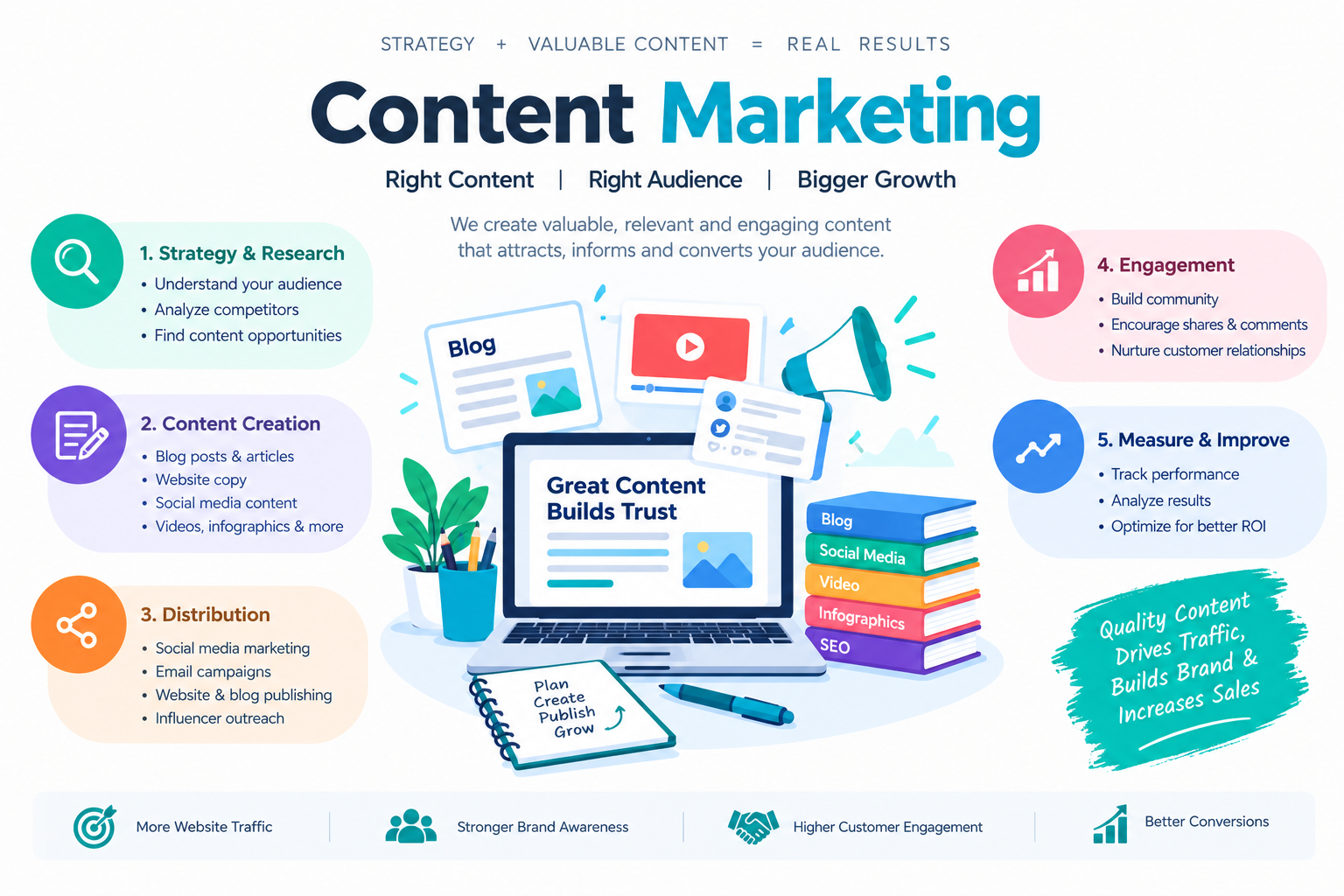
Content marketing is the practice of attracting customers by being genuinely useful, instead of chasing them with ads. It works because people trust businesses that answer their questions. These are the tactics that still work in 2026, in a simple order you can follow.
Key takeaways
- Plan content around questions your buyers ask, not around what you want to say.
- Depth beats volume: fewer, better, more complete articles outperform many thin ones.
- Repurpose each piece into several formats to get more from the work.
- Measure leads and conversions, not just page views.
Think like a publisher
A publisher builds an audience first and sells second. Pick a clear set of topics your business can speak about with authority, publish on a steady schedule and make every piece worth sharing. Consistency matters more than bursts of activity, because search engines and readers both reward sites that keep delivering.
Start by listing the 20 questions customers ask before they buy. Each question is a potential article, and together they form your first topic cluster.
Build content that ranks in search
- Match search intent. Look at what already ranks and give a more complete, current and practical answer.
- Write for people first, then structure for search: clear headings, short paragraphs, a table of contents and a direct answer near the top.
- Go deep. Comprehensive guides that cover a topic end to end tend to earn more rankings and links than short posts.
- Link related articles together and to your service pages so readers and search engines understand how your content connects.
- Show experience: real examples, screenshots, numbers from your own work and named authors.
This is the same cluster approach we use on our own site, where each guide supports a service page such as digital marketing or web development.
Build topic clusters, not isolated posts
A topic cluster is a main page on a broad subject, supported by detailed articles on the questions inside it, all linked together. It shows search engines that you cover the subject in depth, and it guides readers from a general question to a service they can buy.
Our own site works this way. The web development services page is the main page, and guides such as how much website development costs in India and WordPress vs custom development answer the questions buyers ask before they enquire. Each guide links up to the main page, and the main page links back to the guides.
- Choose one service or topic you want to be known for.
- List the 10 to 20 questions buyers ask about it.
- Write one thorough article per question.
- Link every article to the main page and to the related articles.
A simple workflow for each article
- Brief: the question, the reader, the search phrase and what the reader should do next.
- Outline: headings that follow the reader's questions in order.
- Draft: write plainly, with real examples and numbers from your own work.
- Edit: cut repetition, check facts and add links to related pages.
- SEO check: title, description, headings, image text and internal links.
- Publish and promote: share it and send it to your list.
- Review: look at the results after a few weeks and update what needs it.
A repeatable workflow lets different people on your team produce content of the same quality.
Choosing the right content format
| Format | Works best for | Effort |
|---|---|---|
| In-depth guide | Search traffic and trust on a topic | High |
| Comparison or checklist | Buyers who are choosing between options | Medium |
| Case study | Proof for people close to deciding | Medium |
| Short video | Social reach and explaining a process | Medium |
| Infographic | Sharing and earning links | Medium to high |
| Email series | Keeping in touch with people who already know you | Low once set up |
Match the format to where the reader is. People researching need guides, and people about to decide need case studies and comparisons.
Write headlines that earn the click
A good headline promises a specific benefit and includes the main search phrase near the start. Compare "Marketing Tips" with "7 Content Marketing Tactics That Bring Organic Leads". The second tells the reader exactly what they get. Keep titles under roughly 60 characters where possible so they are not cut off in results.
Distribute, do not just publish
- Share on the platforms where your buyers actually are: LinkedIn for B2B, Instagram or YouTube for consumer brands.
- Make sharing easy with visible share buttons near the top or side of the page.
- Send new articles to your email list and mention them in relevant communities where it is allowed.
- Reach out to people you quoted or linked to. Earned links and mentions grow authority.
Repurpose every piece
One solid article can become several assets: a LinkedIn carousel, a short video, a slide deck, an email series, an infographic and a checklist download. Repurposing saves effort and meets people in the format they prefer. Add an embed or share option to infographics so other sites can use them and link back.
Turn readers into enquiries
Content that brings visitors but no enquiries is half finished. Every article should tell the reader what to do next, and the step should suit where they are in their decision:
- A guide for early research can offer a related guide, a checklist or an email sign-up.
- A comparison or cost article can offer a short consultation.
- A case study can offer a conversation about a similar project.
Place one clear call to action in the middle of the article and another at the end, and make the contact route simple: a short form, a phone number or a messaging link.
Measure what matters
Track organic traffic and impressions in Google Search Console, then follow visitors into Google Analytics to see which articles lead to enquiries, calls or sign-ups. Update articles that almost rank, merge thin ones and double down on topics that bring qualified leads.
Content is a long game. Most businesses need several months of steady publishing before the effect compounds. If you want help planning it, our digital marketing team can build a content calendar around your services. See also our guide to the best SEO tools.
A 90-day content plan
- Days 1 to 30: choose your topic, list the buyer questions, write the first two cornerstone guides and set up tracking.
- Days 31 to 60: publish four more articles in the cluster, link them together and share each one in the places your buyers read.
- Days 61 to 90: review which pieces get impressions and clicks, update the weakest, and plan the next cluster based on what worked.
This pace suits a small team. It is better to finish a modest plan than to start an ambitious one and stop after a month.
Content marketing mistakes to avoid
- Publishing without a topic plan.
- Writing about yourself instead of the reader's questions.
- Copying competitors' articles rather than improving on them.
- Leaving old articles unchanged for years.
- Measuring only page views, not enquiries.
- Giving up after two months.
Keeping content fresh
Content is not finished when it is published. Review your most important articles every few months and update facts, examples, links and screenshots. Refresh the introduction so it matches what searchers want now, add new questions that readers have asked and remove advice that is out of date. A refreshed article often performs better than a new one, and it costs far less to produce.
Frequently asked questions
What is content marketing in simple terms?
It is creating useful articles, videos and guides that attract and educate potential customers, so they trust and choose your business.
How often should I publish?
Quality and consistency matter more than frequency. Many small businesses do well with 2 to 4 strong articles a month.
How long before content marketing works?
Usually 3 to 6 months to see traction and longer for a strong return, since content builds authority over time.
Does long-form content rank better?
Depth tends to help because it answers the question fully, but length alone does not. Clarity and usefulness matter most.
What is a topic cluster?
A topic cluster is a main page on a broad subject, supported by detailed articles on related questions, all linked together. It helps readers and search engines see that you cover the subject in depth.