In this article
Choosing an app development company in 2026 is about far more than writing code. You need an app that is fast, secure, ready to grow and maintainable for years. Noida is one of India's main hubs for Android and iOS work, but most companies sound identical. Here is how to tell them apart.
Key takeaways
- Scalability is a design decision made at the start, not a feature added later.
- Ask about process, ownership of source code and post-launch support, not just portfolio screenshots.
- Very low quotes usually hide rushed work, missing testing and surprise costs.
- A good partner plans before coding and stays after launch.
Why Noida is a strong app development hub
Over the past decade Noida has become a major product and technology cluster, with clients from India, the US, Europe and the Middle East.
- Deep talent pool: Android (Kotlin, Java), iOS (Swift), cross-platform (Flutter, React Native), plus backend and cloud engineers.
- Good balance of cost and quality compared with large metros and many overseas agencies.
- Experience with global startups, SaaS, ecommerce and fintech products.
What "scalable app development" really means
Scalability is a design approach, not a checkbox. A scalable app keeps performing as users grow, lets you add features without breaking existing ones, handles heavier traffic, keeps data secure and can ship updates without risk.
Apps that skip this often slow down, crash under growth and need an expensive rewrite within 12 to 18 months. Good teams spend time on planning and structure first.
What an app development company does beyond coding
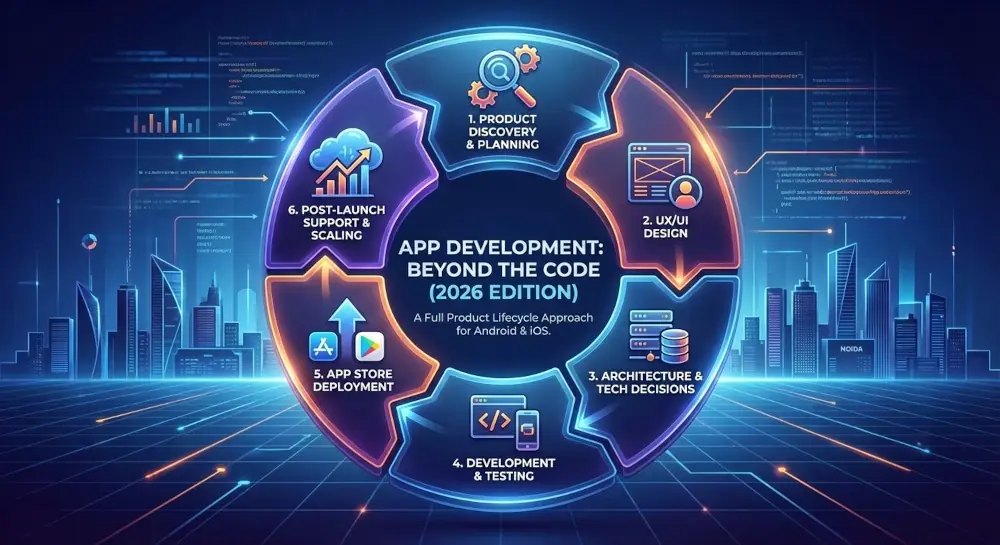
- Product discovery: clarifying goals, user journeys, feasibility and risks.
- UX/UI design: usability, retention, conversion flow and platform-specific behavior for Android and iOS.
- Architecture: native vs cross-platform, backend, database, APIs and cloud choices.
- Development and testing: maintainable code, real-device testing, performance and security checks.
- Store deployment: compliance, metadata, privacy policy and handling rejections.
- Post-launch support: updates, analytics, fixes and new features.
Services to expect
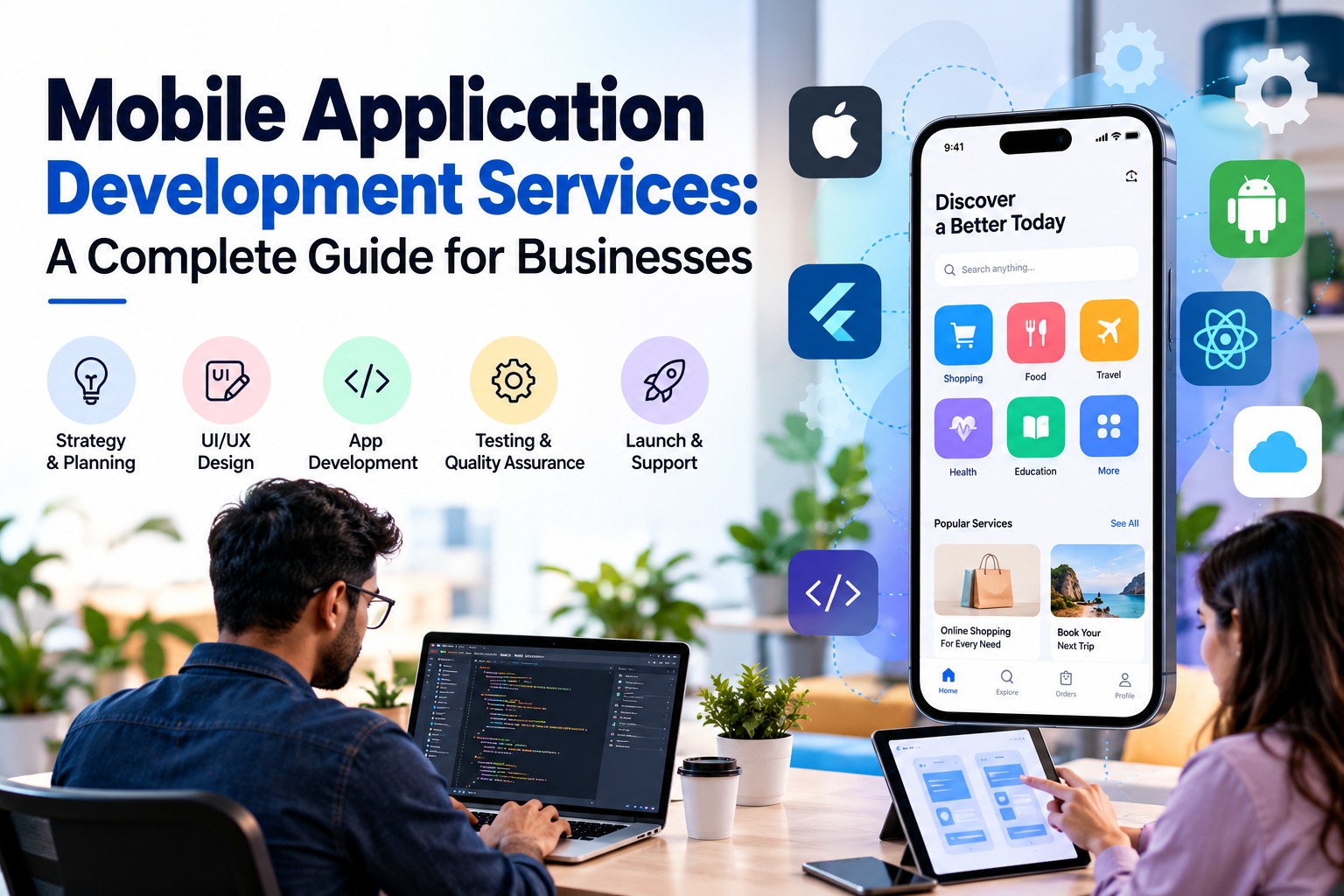
- Android app development with Kotlin or Java
- iOS app development with Swift, following Apple's design and security guidelines
- Cross-platform apps with Flutter or React Native for faster delivery from a shared codebase
- Backend, API and cloud development (AWS, GCP and others)
- App maintenance, bug fixing and performance work
You can see how we deliver these on our mobile app development services page, and browse real examples in our case studies.
How to choose the right app development company
1. Do not judge by screenshots alone
Ask what problem each app solved, how many users it has and whether the company still maintains it.
2. Ask about their process
You should hear clear stages: discovery, design, development, testing, deployment and support. Vague answers are a warning sign.
3. Check communication and transparency
Who is your point of contact? How is progress shared? How are delays and scope changes handled? Poor communication causes more failures than poor code.
4. Confirm code ownership
You should own the source code, have repository access and receive documentation. Avoid vendor lock-in.
5. Be wary of unrealistically low quotes
The cheapest quote often means rushed development, light testing, no scalability planning and costs that appear later.
Native or cross-platform? A quick guide
- Cross-platform (Flutter, React Native): one codebase for Android and iOS. A good fit for most business apps, with faster delivery and shared maintenance. Our Azoi case study is built this way.
- Native (Kotlin for Android, Swift for iOS): separate apps for each platform. Best for heavy graphics, advanced device features or the very highest performance, with more effort because there are two codebases.
Ask each company why they recommend one over the other for your app. A good answer refers to your features and users, not to the tool they prefer. For how the choice affects budget, see our guide on mobile app cost in India.
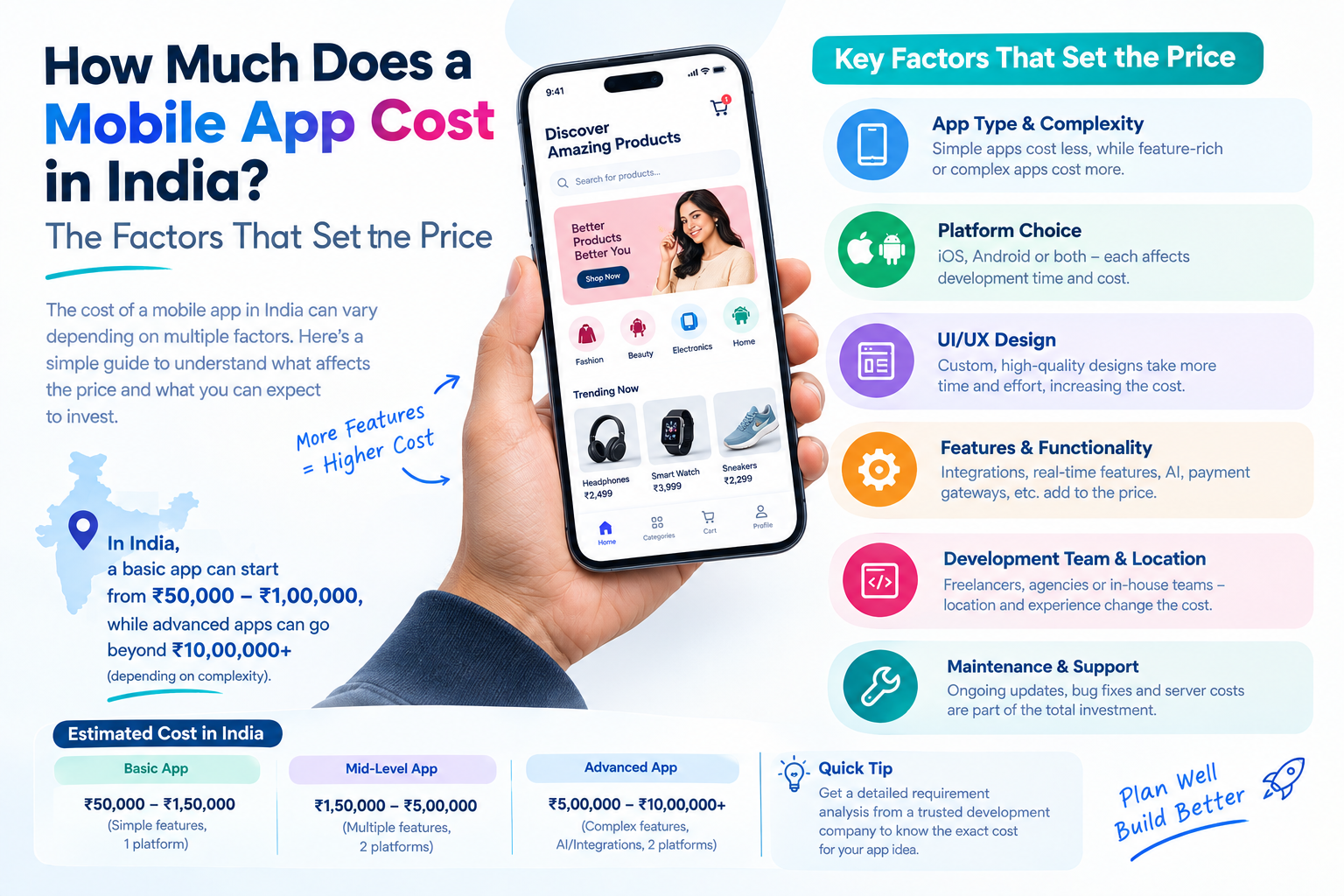
What affects app development cost
There is no standard price. The main drivers are:
- Complexity and number of features
- Android, iOS or both
- Design depth and custom animations
- Backend, integrations and payments
- Security, compliance and admin tools
- Ongoing hosting, maintenance and store updates
A basic app has simple features and limited users. A mid-level app adds login, a backend and integrations. A complex app adds payments, analytics, admin systems and scalable infrastructure. The cheapest app is rarely the cheapest over its lifetime.
Typical app development process
- Discovery and requirement analysis
- UI/UX design: wireframes, visual design and testing
- Development: front end, backend and API integration
- Quality assurance: functional, performance and security testing
- Deployment: Play Store and App Store submission
- Maintenance and scaling: updates and new features
Questions to ask before you sign
- Who will work on my app, and can I meet them?
- Can I see live apps in the stores, not only screenshots?
- How often will I see a working build?
- Who owns the source code, the designs and the store accounts?
- How do you test, and on which devices?
- What does support after launch include, and what does it cost?
- What is not in this quote?
Specific answers are a good sign. A company that dodges code ownership or support is telling you something.
What a good app proposal includes
- A list of screens and features, written clearly.
- Which platforms and technologies will be used, and why.
- A timeline with milestones and demo dates.
- A price with what is included and excluded.
- The testing approach and the devices covered.
- Support and maintenance terms after launch.
Compare proposals line by line. The cheapest total can hide missing items such as the admin panel, testing or store submission.
Red flags when choosing an app developer
- A price quoted without asking about your goals or features.
- No live apps to show, or apps that are no longer available.
- Refusal to share the code or to put the store accounts in your name.
- No mention of testing or security.
- Pressure to pay the full amount upfront.
- No named point of contact.
Why businesses choose Ucodice
We build products meant to grow, not just apps that launch. That means planning before development, scalable architecture from day one, AI used to speed up work rather than replace engineering, transparent communication and a long-term relationship. We work with startups and established businesses that need apps with real users and measurable results. Read our view on using AI to build apps or talk to our team about your idea.
A short checklist for your shortlist
- Three to five companies with work similar to yours.
- At least one live app from each that you can download and try.
- A call with each, including someone who will actually work on the project.
- Written proposals that you can compare line by line.
- A clear answer on code ownership and support from every company.
Choose the company that answers your questions most clearly, not the one that promises the most. If you would like to talk through your app, see our mobile app development services or contact us.
Why a local team can help
Many Noida app companies work with clients across India and abroad, and distance is rarely a barrier with weekly video demos. A local team still has real advantages. You can meet in person for the discovery workshop, review designs together on a large screen and resolve disagreements faster than over email. If your app needs on-site work, such as a kiosk, a warehouse tool or a field-team app, being near the team makes testing easier. Decide how much in-person contact you want, and ask each company how they would handle it.
Frequently asked questions
Which is the top app development company in Noida?
The best choice depends on your goals, budget and scale. Compare experience, process, communication and post-launch support instead of choosing on price or name.
How long does it take to build an Android or iOS app?
It depends on complexity. Simple apps can take a few weeks; most professional apps take a few months from planning to launch.
Do Noida app companies work with international clients?
Yes, many work with clients across the US, Europe, the Middle East and beyond, using regular calls and shared project tools.
Is post-launch support included?
It should be discussed up front. Reliable companies offer maintenance and updates because apps need ongoing care to stay secure and compatible.
Should I choose native or cross-platform?
Cross-platform (Flutter or React Native) is faster and more economical for many products. Native suits apps needing the deepest device features or top performance. A good partner will recommend based on your needs.