In this article
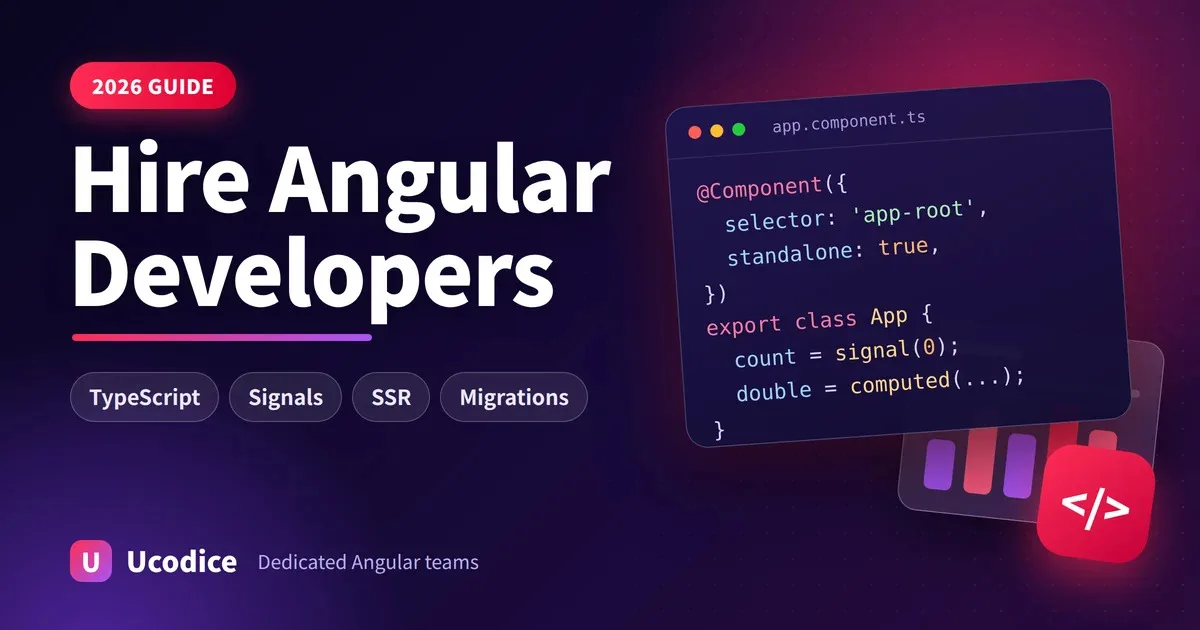
Angular is a strong choice for large, long-lived web applications, but hiring the right developers takes more than finding someone who lists it on a CV. This 2026 guide covers the skills modern Angular developers need, how Angular compares with React and Vue, how engagement models and costs work, and how to vet candidates.
Key takeaways
- Look for modern Angular skills: standalone components, signals, new control flow and SSR, not just "Angular 2".
- Angular suits large enterprise apps and big teams, while React or Vue may fit flexible or smaller products.
- Compare what each quote covers (development, testing, project management), not just the price.
- A short paid trial and a technical discussion are the best ways to vet a developer.
Why companies still choose Angular
Angular is Google's TypeScript framework for building web apps. Developers pick it when they want one complete framework instead of many libraries stitched together. Routing, forms, HTTP services, testing tools and command-line tooling all come bundled.
It is a particularly good fit for:
- Enterprise and internal tools such as dashboards, admin panels, CRMs and ERP front ends
- Large, long-lived applications with many developers working in one codebase
- Regulated industries such as finance and healthcare, where structure and testability matter
- Teams that already use TypeScript and value strong typing
Angular has changed a great deal since its early versions. It follows a regular release schedule with a major release every six months, and recent releases focus on faster rendering and simpler code. Check the latest stable version on angular.dev before starting any new project. For a deeper look at the framework, read our guide to the benefits of Angular development.
What modern Angular developers should know
Job descriptions from a few years ago ask for "Angular 2" or "Angular 4". That is a warning sign that a candidate may need to catch up, because only recent Angular versions are maintained. Look for experience in these areas:
| Skill area | What to look for |
|---|---|
| Core Angular | Standalone components (now the default for new projects), dependency injection, routing and lazy loading |
| Reactivity | Signals alongside RxJS, and knowing when to use each |
| Templates | The newer built-in control flow syntax and deferred loading |
| Rendering | Server-side rendering and hydration for speed and SEO |
| Forms | Reactive forms, and awareness of newer signal-based form APIs |
| State management | NgRx or signal-based state patterns for larger apps |
| TypeScript | Strict typing, generics and clean architecture |
| Testing | Unit tests, component tests and end-to-end tests |
| Performance | Bundle size, change detection, lazy loading and Core Web Vitals |
| Accessibility | Semantic HTML, keyboard support and screen-reader basics |
| Tooling | Angular CLI, CI/CD pipelines and code review habits |
Some of these features became stable in different versions, so check the Angular documentation for your version.
Angular vs React vs Vue: which should you choose?
Angular is not always the right choice. Here is a fair comparison:
| Angular | React | Vue | |
|---|---|---|---|
| Type | Full framework | UI library plus ecosystem | Progressive framework |
| Learning curve | Steeper | Moderate | Gentler |
| Structure | Strongly opinionated | Flexible, your choice of tools | Balanced |
| Best for | Large enterprise apps and big teams | Flexible products and large ecosystems | Smaller to mid-size apps and quick builds |
| TypeScript | Built in and central | Supported | Supported |
If you have a large team, your app will live for many years and you need consistent structure, Angular is a good option. If you need a lot of flexibility or the biggest possible talent pool, React may suit you better.
Engagement models and cost
Most clients use one of three models:
| Model | Best for | How it works |
|---|---|---|
| Dedicated Angular developer(s) | Ongoing product work | Developers work only on your project, as an extension of your team |
| Part-time or hourly | Smaller tasks, audits, fixes | You buy a set number of hours each month |
| Fixed-scope project | Clearly defined builds or migrations | One agreed scope, timeline and price |
Pricing
We quote after a short scoping call, because the right price depends on the model, team size and project scope. Tell us what you need and we will send a clear estimate.
What affects cost: developer seniority, team size, project length, integration complexity and how much testing is needed. Offshore teams like ours cost far less than hiring in-house in North America or Western Europe, but the cheapest quote is not always the best value. Compare what each quote covers: development, testing and project management.
How we hire and onboard
- Share your needs. Tell us your goals, technology stack, team size and start date.
- Receive matched profiles. We send developer profiles that fit your requirements.
- Interview and trial. You interview the developers, and you can start with a short paid trial.
- Onboard. We set up access, tools and communication, with working hours that suit your time zone.
- Deliver and review. You get regular demos, code reviews and reports, and you can scale the team up or down.
Angular migration and upgrades
Many clients come to us with older applications that are slow, hard to maintain and no longer updated. Typical cases are:
- AngularJS (1.x) apps. AngularJS reached end of life in December 2021, so it gets no official updates. Migration means a rewrite or a gradual, staged move.
- Older Angular versions, which carry security and compatibility risks.
- NgModule-based apps that you want to move to standalone components and the newer template syntax.
- Performance problems such as slow initial load, heavy bundles or poor Core Web Vitals.
Our standard process starts with an assessment of the code, dependencies and tests, then plans incremental upgrades with testing after each step. If you only need an analysis report, we can provide an Angular health check.
How to vet an Angular developer
Whether you hire from us or elsewhere, use an organized process.
Questions worth asking
- What is the difference between signals and observables, and when would you choose one over the other?
- How do standalone components change the architecture of an application?
- How would you speed up a slow-loading Angular application?
- How do you manage state in a large application?
- How do you structure unit and end-to-end tests?
- Tell me about a migration you have worked on.
Green flags
- Gives real-world examples and explains pros and cons
- Writes unit tests as part of development
- Knows current Angular, not just the first version they learned
- Asks questions and communicates clearly about your goals
Red flags
- Only familiar with older Angular conventions
- Cannot explain decisions about performance and testing
- Promises unrealistic timeframes without asking about scope
- Declines a paid trial or a technical discussion
Ready to hire Angular developers?
Tell us about your project, technology stack and timeline. We will send matching profiles and a proposal.
Talk to our team | Web development services
Frequently asked questions
How much does it cost to hire an Angular developer?
The price depends on experience level, location and engagement model. Offshore teams are usually far cheaper than teams in North America or Western Europe. It is important to compare everything the price covers.
How quickly can I get an Angular developer?
It depends on the skills you need and how quickly you complete interviews. Share your stack and start date and we will give you a realistic timeline.
Is Angular still worth using in 2026?
Yes, particularly for large, long-lived, enterprise-scale applications. Google maintains it well, it has a defined release cycle, and recent versions focus on faster rendering and less complexity. For small or highly flexible apps, consider React or Vue.
Can you upgrade or migrate my old Angular or AngularJS application?
Yes. We begin with an audit and then upgrade in stages, testing at each step. AngularJS (1.x) migrations tend to be bigger because AngularJS reached end of life in December 2021.
Do you offer a trial period?
Yes. A short paid trial is the best way to assess technical skill and communication before you commit further.
Will the developers work in my time zone?
We align our working hours with your team. Tell us your time zone when you contact us.